Amazon KDP as a Side Hustle — Build Your KDP Business From ₹0 to ₹10,000/Month
Amazon KDP as a Side Hustle Ebook
₹99 Get this ebook
A beginner’s roadmap to real income

Build your Amazon KDP side hustle — even if you’re starting from zero.

The complete beginner-to-first-payout guide: how KDP works, how royalties are calculated, what to publish, how to create and publish it, and how a small catalogue compounds toward ₹10,000 a month.

Amazon KDP as a Side Hustle
How to Build a Profitable Self-Publishing Business on Amazon — From ₹0 to ₹10,000 a Month
Zero experience needed Step-by-step system Free & paid tools covered
Get this ebook
₹99 One-time payment
Instant digital access after payment
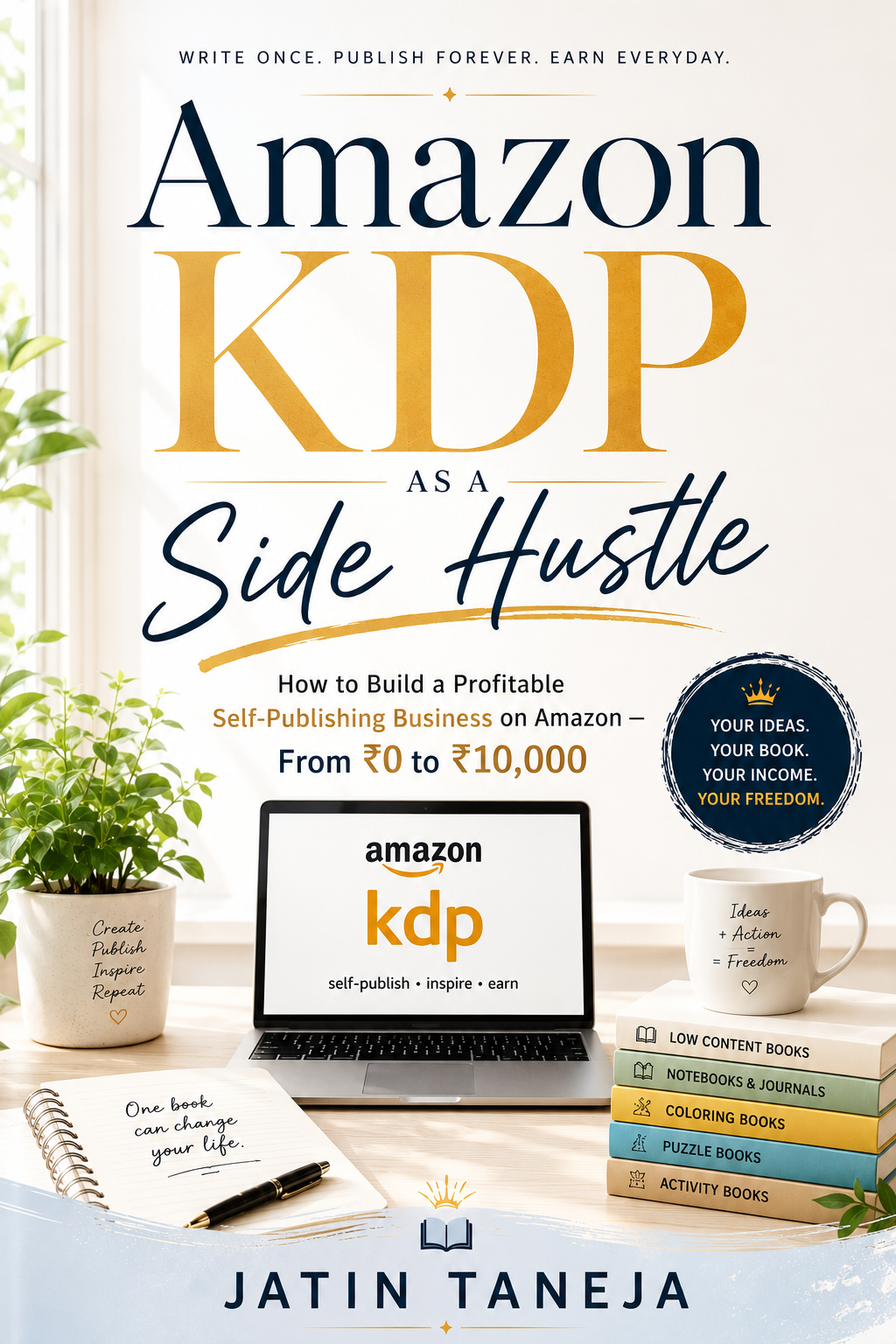
Cover of the ebook Amazon KDP as a Side Hustle by Jatin Taneja
Where beginners get stuck

KDP sounds simple. Starting it isn’t.

Publishing on Amazon is genuinely free and genuinely open to anyone. That’s exactly why it’s confusing: there is no one telling you what to do first, and every video answers a different question. Most people stall on one of these.

01
What type of book should I even publish?
02
Which niche — and is it already saturated?
03
Does anyone actually want this book?
04
How do keywords and categories work?
05
How do royalties actually get calculated?
06
Do I have to write it all myself?
07
How do I format a manuscript and build a cover?
08
What do I click inside KDP, and in what order?
09
What price should I set?
10
How do I get reviews without breaking Amazon’s rules?
11
How does anyone find my book at all?
12
How do I get past one book to a catalogue?
This book puts the pieces in the right order — and tells you which one to do next.
See what’s inside
The shift

From guessing to a working sequence.

Before
“I have no idea where to start.”
After
“I have a step-by-step KDP roadmap.”
Before
“Which niche should I choose?”
After
“I know how to research and validate demand.”
Before
“How do I actually publish?”
After
“I know the publishing workflow end to end.”
Before
“How do I make this more than one book?”
After
“I understand catalogue-based growth.”

The book gives you the process and the mechanics. The results still depend on the research you do and the books you produce.

Inside the book

Six parts, in the order you actually need them.

22 chapters across six parts, plus an appendix. Each chapter ends with a checklist you can act on immediately.

Part 01

Understanding the business

How KDP works and what it costs you (nothing, to start). The two eBook royalty tiers, print royalties, Kindle Unlimited page-reads, and how Indian authors get paid. Then the real arithmetic behind the ₹10,000/month target.

Part 02

Choosing what to publish

The four types of KDP books and which suits your time and skills. Niche and keyword research, reading competition honestly, and validating an idea before you spend hours producing it. Includes 25 beginner-friendly niche starting points.

Part 03

Creating your book

Planning and outlining, a one-page book brief, writing with AI used responsibly and disclosed correctly, formatting for Kindle and print, and designing a cover that still reads at thumbnail size.

Part 04

Publishing on KDP

Account setup and the US tax interview, then the complete publishing walkthrough — metadata, description structure, seven backend keywords, categories — and the KDP Select vs. going wide decision.

Part 05

Getting sales and reviews

Pricing for profit inside the 70% band, getting your first reviews the compliant way, marketing on a zero-rupee budget, and a plain-English introduction to Amazon Ads.

Part 06

Scaling to ₹10,000 and beyond

The math of scaling a catalogue, a complete worked case study from idea to first payout, a reusable production system, the mistakes that get accounts banned, and a 30-60-90 day action plan.

Get this ebook
₹99 One-time payment
The difference

This is not just another KDP guide.

Most KDP advice falls into one of two traps. This book was written specifically to avoid both: beginner-friendly without being shallow.

Trap one

Guides that assume you already understand publishing

They skip the basics and leave you searching for what a royalty tier, trim size or backend keyword actually is.

Trap two

Thin “make ₹50,000 overnight” hype

Recycled promises with no real mechanics behind them — nothing you can sit down and execute tomorrow.

This book

Written for someone who has never done any of it

No assumed publishing knowledge, real mechanics, realistic income math, and a stated order of operations from niche to catalogue.

No assumed publishing knowledge
Practical mechanics, not motivation
Realistic income math
Research before production
A step-by-step workflow
Compliance built in
Catalogue-based thinking
A dated action plan
Chapter 3 & 18

The ₹10,000/month number, done as arithmetic.

Not a promise — a planning model. The book shows you the formula, then walks the numbers so you know what has to be true for the milestone to arrive.

The core formula
Catalogue size
×
Avg. sales per book
×
Avg. royalty per sale
=
Monthly royalty income

Every lever in that formula is one you can influence. None of them has to become huge — they only have to grow together.

A worked example: eBooks priced around ₹199

≈ ₹135–140 royalty per sale
Books
Total monthly sales
Est. royalty
2
4 sales
≈ ₹550
5
15 sales
≈ ₹2,050
9
32 sales
≈ ₹4,400
12
60 sales
≈ ₹8,300
16
83 sales
≈ ₹11,400

Illustrative planning model — not a guarantee. These figures come from the book’s worked example of how royalties, pricing and catalogue size interact. Your own numbers will differ.

You don’t need one viral bestseller. You need a catalogue and a repeatable system.
Get this ebook
₹99 One-time payment
Chapter 22

A 30-60-90 day plan you could start on Monday.

Knowledge without a schedule rarely turns into action. The final chapter turns the whole book into a dated checklist.

1
Days 1–30
Foundation
Learn the system and take your own notes on key decisions
Research and validate 3–5 candidate niches; pick one
Write your one-page book brief and full outline
Draft the manuscript, with responsible AI assistance where useful
Complete one editing and one proofreading pass
2
Days 31–60
First launch
Format via Kindle Create and preview across devices
Design your cover, testing readability at thumbnail size
Set up your KDP account and complete the tax interview
Publish with full metadata, keywords and a deliberate pricing / Select decision
Add your honest review-request page; begin zero-budget promotion
3
Days 61–90
Build the catalogue
Review your first book’s early performance and note the lessons
Research and begin producing books two and three
Apply the reusable production pipeline
Consider a small, tested Amazon Ads campaign on a title with reviews
Revisit the income model with your own real numbers

Only about an hour a day? The book addresses that directly: the process doesn’t change, the calendar stretches.

Chapter 19 — worked case study

See the system applied to one realistic example.

One title — an ADHD-friendly daily planner — followed from a blank idea to its first payout. It exists so the chapters stop being isolated theory and start being one connected sequence.

01
Niche & validation
Real but manageable competition confirmed, with a clearly named reader.
02
Book brief
Trim size, page count, spread structure and the specific reader features decided up front.
03
Production
One core spread designed carefully, then repeated and lightly varied across the interior.
04
Cover
Benchmarked against existing planner covers; AI imagery used with rights confirmed and disclosed.
05
Publishing
Description written to a set structure, seven researched backend keywords, two specific categories.
06
Pricing & KDP Select
Priced inside the 70% band to match niche norms; enrolled in Select for promo tools and KU reach.
07
Launch
Compliant back-matter review request, a genuine community announcement, and a short free promotion.
08
First month
11 organic sales, 3 honest reviews from free-promotion readers, modest but real KU page-reads.
09
Scaling
A small tested ad campaign, then a companion title planned for the same audience.
What this one book contributed

The book estimates this single title might contribute roughly ₹1,500–₹3,000 a month within its first two to three months — nowhere near ₹10,000 alone, but exactly the kind of building block the catalogue math depends on.

These are the book’s own worked, illustrative figures used to teach the process. They are not a promise of results, and no reader outcomes are being claimed here.

Get this ebook
₹99 One-time payment
Work through it

Processes and checklists, not just chapters.

This isn’t something you simply read. Every chapter ends with a checklist, and the appendix collects the whole thing into one page.

Niche research process
Niche validation checklist
Keyword research
Backend keyword guidance
One-page book brief
Formatting guidance
Cover design guidance
Publishing workflow
Pricing framework
Compliant review strategy
Zero-budget marketing
Amazon Ads introduction
Catalogue scaling math
Reusable production pipeline
30-60-90 day action plan
Tool directory
Glossary of KDP terms
Final one-page checklist
Tools

You can start with free tools.

The appendix lists a free option for every stage of production, and a paid option beside it — clearly marked as optional and for later, once royalties are actually arriving.

The book also gives a reinvestment order for your first royalties, so paid tools come in on evidence, not on impulse.

Free — enough to publish your first book
Amazon search & autocomplete Amazon category pages Google Trends Kindle Create Word / Google Docs Canva free tier GIMP KDP Cover Creator Free AI tool tiers Free grammar checkers
Optional, later
Professional formatting Premium cover design Paid AI subscriptions KDP keyword research tools Freelance editors Amazon Ads
Chapter 8

Yes, you can use AI — but you need to use it properly.

AI can genuinely help you produce a book. What it cannot do is take responsibility for quality, or make Amazon’s disclosure requirement go away.

The book explains the distinction Amazon draws, walks a responsible workflow where your outline and your voice stay in charge, and shows how the disclosure step actually works during publishing. It also explains why paraphrasing tricks are the wrong answer.

AI-assisted

No disclosure

You wrote the content; AI helped you brainstorm, outline, edit, proofread or refine your own words.

AI-generated

Disclosure required

AI produced the text, images or translation appearing in the final book — even if you edited it afterward. You check the relevant boxes honestly during publishing.

It is undisclosed AI content — not AI use itself — that puts an account at risk.

Chapter 21 — compliance

Build the business without risking your KDP account.

A suspended account can cost you every book and every royalty stream at once. This book only teaches methods compliant with Amazon’s KDP terms and content guidelines — and names the shortcuts to stay away from.

×Paid, swapped or incentivized reviews
×Undisclosed AI-generated content
×Plagiarised or thin republished content
×Keyword stuffing and misleading claims
×Multiple accounts used to manipulate rankings
×Breaking KDP Select’s exclusivity terms

Amazon updates its terms, royalty rates and content policies periodically. The book says so throughout, and tells you to verify current rules on kdp.amazon.com before you publish.

Fit check

Is this book for you?

Yes, if…

You’re completely new to KDP
You want a structured starting point
You don’t know what type of book to publish
You want to learn niche research properly
You want the publishing workflow, step by step
You want to understand royalties and pricing
You’d rather build a catalogue than bet on one book
You want a realistic roadmap, not a fantasy
You want to use AI responsibly and disclose it correctly
You want to avoid tactics that put an account at risk

Probably not, if…

×You’re looking for guaranteed income
×You want overnight passive riches
×You don’t want to research or produce quality books
×You’re looking for shortcuts that break Amazon’s rules

“You don’t need to be a great writer to succeed on KDP. You need to be a good researcher, a careful producer, and a consistent publisher.”
From the introduction
Amazon KDP as a Side Hustle ebook cover
Everything included

The complete KDP roadmap, in one book.

6 parts 22 chapters 100+ pages Appendix & glossary
+KDP fundamentals
+Royalty & pricing framework
+Niche research system
+Validation process
+Book creation workflow
+Responsible AI guidance
+Formatting guidance
+Cover guidance
+Publishing walkthrough
+KDP Select explained
+Compliant review strategy
+Zero-budget marketing
+Amazon Ads introduction
+Catalogue scaling math
+Worked case study
+Production system
+Compliance guidance
+30-60-90 day action plan
+Tool directory
+Glossary
+Final checklist
Get this ebook
₹99 One-time payment
Questions

Answered before you buy.

No. The book is written for someone who has never formatted a manuscript, never designed a cover, and doesn’t know what a royalty tier or a backend keyword is. It defines every term as it goes.
No. As the book explains, Indian authors are paid directly to an Indian bank account. You will need a PAN card and to complete KDP’s standard online US tax interview so the correct treaty withholding rate is applied to US-marketplace sales.
Not at the beginner stage described in the book — you can start as an individual using your personal PAN and bank account. The book advises revisiting this with a chartered accountant only once your income grows significantly.
You need to be able to write, or to plan content carefully and use AI tools responsibly to help produce it. The book also covers low- and medium-content formats — journals, planners, puzzle books — where research and design matter more than prose.
Yes — with honest disclosure where AI produced the final content. Chapter 8 explains Amazon’s AI-assisted vs. AI-generated distinction, how the disclosure step works during publishing, and a workflow that keeps you responsible for quality.
KDP is Amazon’s free self-service publishing platform, with no upfront cost to publish. There is no inventory: eBooks are digital, and paperbacks and hardcovers are print-on-demand, with printing cost deducted from each sale’s royalty.
No. The appendix lists a free option for every stage — Kindle Create, Word or Google Docs, Canva’s free tier, GIMP, KDP’s Cover Creator, Amazon’s own search and category pages, Google Trends. Paid tools are presented as optional and for later.
The book’s illustrative timeline is roughly four to eight months of consistent publishing for a careful beginner building toward a 12–16 title catalogue. Some will get there faster with a stronger niche; others will take longer. It is a planning model, not a schedule you’re owed.
No, and the book says so plainly. Self-publishing income depends on your niche, your effort, your marketing, market conditions and Amazon’s own policies. Every figure in the book — including the ₹10,000/month roadmap — is an illustrative planning model, not a guarantee.
Yes — the book addresses this directly. An hour a day is around seven hours a week, enough for one low or medium-content book every two to three weeks, or a standard non-fiction book every six to eight weeks once you’re comfortable with the pipeline. You stretch the calendar, not the process.
Yes — Chapter 15 covers getting your first reviews the compliant way, including back-matter review requests and ARC readers who disclose. It explicitly does not teach paid, swapped or incentivized reviews, which risk your account.
Both. Chapter 17 is an introduction to Amazon Ads, including how to judge a campaign by ACOS. Chapter 13 covers the KDP Select vs. going wide decision — Kindle Unlimited reach and promotional tools in exchange for digital exclusivity.
Yes. It covers all three KDP formats, how print royalties are calculated after printing cost, and formatting for print — while recommending the Kindle eBook as your first format, since a paperback edition can be added to the same listing later.
Amazon updates pricing bands, royalty rates and content policies periodically, and the book flags this throughout. The processes stay useful; the book tells you to verify current royalty rates, pricing rules and content policies on kdp.amazon.com before publishing.
Payment is handled by the payment gateway. Once your payment succeeds, you’re taken straight to a download page where you can save the ebook to your device.
Honest expectations

No hype. Just a practical roadmap.

KDP is a real business. It needs research, a properly produced product, and consistent publishing. The book won’t promise you passive riches with no work — what it does is remove the excuse of “I don’t know how.”

₹10,000 a month is a deliberately modest first milestone with the arithmetic shown, not a promise. Treat the first months as learning and system-building rather than a profit test.

Research Quality production Consistent publishing Patience Learning Iteration

You’re not buying a fantasy. You’re buying a process.

Amazon KDP as a Side Hustle ebook cover

Stop wondering how KDP works. Start learning the system.

You don’t need to know everything before you begin. You need a clear sequence of steps.

Get this ebook
₹99 One-time payment
Instant digital access after payment
Amazon KDP as a Side Hustle
How to Build a Profitable Self-Publishing Business on Amazon — From ₹0 to ₹10,000 a Month
© 2026 {{ authorName }}. All rights reserved.
Pages
Please note

This is an independent educational ebook and is not affiliated with, endorsed by, or sponsored by Amazon. Amazon and Kindle Direct Publishing are trademarks of their respective owner. Figures and timelines discussed in the book are illustrative planning models, not guarantees of income.

Amazon KDP as a Side Hustle
₹99 · Instant access after payment
Get this ebook